 EN



How to Design Custom Pickleball Balls for Tournaments
Custom pickleball balls for a tournament have two jobs: it must be easy to see and suitable for the matches it will serve. A logo can help an event feel distinctive, but a useful design brief for custom pickleball balls starts with the event rules, court conditions and the exact ball model, rather than artwork alone. For organizers coordinating sponsors, officials and suppliers, the sequence matters: confirm eligibility, evaluate a physical sample, then approve production details.
Turn those decisions into a working brief. It also separates promotional custom pickleball balls for giveaways from balls intended for match play, because the two may have different requirements.
1. Define the tournament and its rules first
Write down the venue, indoor or outdoor setting, playing surface, lighting, expected dates and governing organization. Ask the tournament director which rules apply and whether the chosen ball must appear on an approved equipment list. A local recreational event may set its own requirements; a sanctioned event can have stricter conditions. Use the rules applicable on the event date, rather than assuming every tournament follows the same standard.
For events governed by USA Pickleball, the 2026 Official Rulebook says the ball must be one uniform color apart from identification markings, and it must carry a manufacturer or supplier name or logo. The rulebook also requires the ball design to be approved. Before ordering custom pickleball balls, check the current approved-ball list and ask the governing body or tournament director whether the exact model and proposed markings are acceptable. Do not assume that a familiar model remains eligible after any change to its construction or decoration.
The January 2025 USA Pickleball Equipment Standards Manual lists a diameter of 2.87–2.97 inches, a weight of 0.78–0.935 ounces, and 26–40 circular holes. These figures are a dated reference, not a substitute for the current manual or formal approval. The manual also specifies test methods and conditions; checking a few measurements by hand cannot establish certification.
2. Choose the base ball before designing the logo
Ask the supplier to identify the manufacturer, model, construction, available colors of the custom pickleball balls and the status of any relevant approval. Request the document or listing that matches the proposed ball rather than a broad statement about the supplier. If the event is sanctioned, confirm how the decorated version relates to the listed model before committing to a full order.
Indoor and outdoor conditions make sample evaluation useful. View a sample of custom pickleball balls against the actual court and surrounding backgrounds, including under the lighting planned for play. Ask players and officials whether they can track it comfortably during rallies. Appearance under a studio light or on a screen is not the same as visibility during an evening match.
When comparing custom pickleball balls, keep the model consistent while assessing artwork. Otherwise, a difference in the ball itself can be confused with a difference in the print. If several models are under consideration, label the samples and record which model was used in each trial.
Understand molding terms without making performance promises
Some buyers ask for customized rotation molded pickleballs. Treat the manufacturing method as a question for the supplier, not proof that a ball will last longer or play a particular way. Ask how the shell and holes are made, which specifications are controlled, and whether the sample and production lot use the same construction. Compare samples under the conditions that matter to your event, and request test documentation where the rules require it.
Similarly, customized match grade pickleballs is a purchasing description, not a certification. Ask what the supplier means by “match grade,” which tolerances are documented, and who has verified the model for the relevant competition. A quoted label does not replace the governing body's equipment list.
3. Build artwork around visibility and identification
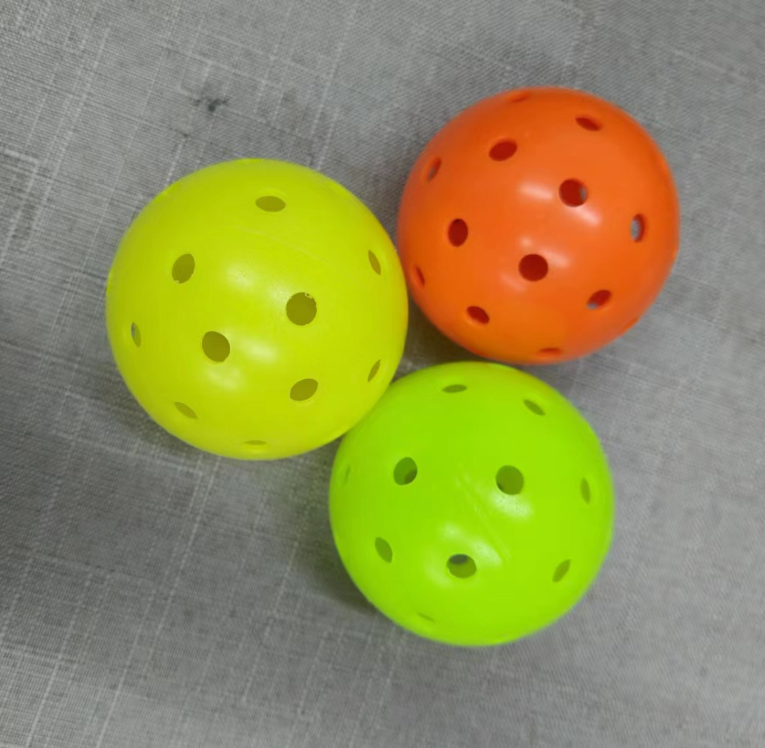
Start with a single, clearly legible event or sponsor mark. Supply vector artwork where possible, plus the approved color values and a contact who can resolve artwork questions. Ask for a proof that shows print size, position, orientation and the relationship between the mark and the ball's holes. Check that the required manufacturer or supplier identification remains visible.
For custom pickleball balls used under USA Pickleball rules, retain the uniform base color and treat any proposed decorative marks as subject to the applicable identification rules. Do not infer that a multicolor pattern is acceptable merely because a printer can apply it. If the desired artwork is complex, put secondary information on the packaging instead and confirm the final design with the event authority.
Review a physical proof of the custom pickleball balls as well as a digital mockup. Check whether small lettering is readable, whether the mark overlaps a hole, and how the surface looks after ordinary handling. Ask the supplier what print process and care instructions apply; do not claim a specific level of ink durability without evidence from that supplier.
4. Test samples and set acceptance criteria
A review of custom pickleball balls is a practical screening step, not a replacement for formal equipment testing. Arrange a short court session using the intended surface and lighting. Have a few people compare visibility, bounce and general feel with the event's reference ball. Record observations separately from measured results, along with the sample model and date.
For a clearer order, agree on the following points in writing:
- Identity: manufacturer, model and any approval reference that applies to the event.
- Appearance: base color, approved artwork, position, size and acceptable print variation.
- Specification: the supplier's stated dimensions, weight and hole design, plus the test documents available for review.
- Sample control: which physical sample is the production reference and how any proposed change will be approved.
- Inspection: how the buyer will report defects, what evidence is needed and how the parties will resolve discrepancies.
Check several custom pickleball balls from the delivered order against the agreed sample. Look for visible cracks, irregular holes or print differences and document anything that needs discussion. A play session can flag concerns, but it cannot by itself confirm compliance with a laboratory standard.
5. Plan quantities, packaging and delivery
Separate match stock, warm-up stock and giveaway stock of custom pickleball balls in the order. Estimate the number of courts and sessions, then add a reserve based on the event schedule and the organizer's replacement plan. Ask officials who can authorize a ball change and how replacement balls will be kept available during play. Avoid relying on an arbitrary spare percentage when the event format and conditions are not yet known.
Confirm the minimum order quantity, price, sample fee, production lead time, shipping method and delivery date directly with the supplier. For custom pickleball balls, leave time to review the proof and inspect the shipment before the event. Put the deadline for artwork approval and the process for resolving a delay in the written order; a design is not useful if it arrives after the matches.
Packaging should identify the event, quantity and ball model. If match and giveaway balls differ, use clearly distinct labels and storage locations so staff do not accidentally put promotional stock into play. Ask for a packing list and keep the approved proof and specification sheet with the receiving documents.
6. Send a concise supplier brief
A complete brief for custom pickleball balls can fit on one page. Include the tournament date and location, applicable rules, model or approval requirement, court setting, ball color, artwork file, quantity, packaging and delivery destination. Add the sample approval deadline and the name of the person who makes the final decision.
Before payment or production, ask the supplier to confirm which details are available, which need review and whether the proposed decorated model is suitable for the intended event. Keep that reply with your artwork approval. The result is a design process that gives the tournament team a clear reference for both the ball on court and the branding around it.
Frequently asked questions
Can an approved ball carry a tournament logo?
The 2026 USA Pickleball rulebook permits identification markings on an otherwise uniform-color ball, but the exact artwork and model still need to satisfy the applicable rules. Check the current requirements and obtain confirmation for the proposed design before ordering.
Does a custom print change how a ball plays?
Do not assume either outcome from the print description alone. Ask the supplier whether the decoration changes the approved model or its documented specifications, and compare a decorated sample with the reference ball. The event authority has the final say on eligibility.
 Hot News



