 EN



What Defines Custom Tennis Racket Balance Tuning?
Balance tuning is one of the clearest ways to turn a racchetta tennis ad misuram from a visual concept into a deliberately specified product. For a brand product manager or sourcing team, the useful question is not simply whether a frame is head light or head heavy. It is whether the chosen balance point, mass, grip configuration, string plan, and target player profile all describe the same product. A racchetta tennis ad misuram should therefore be evaluated as a system, not as a list of isolated numbers.
This matters because balance is easy to name but easy to misunderstand. A buyer may request faster handling, more stable contact, or a particular on-court feel. Those are outcomes to validate through samples and play testing; one balance number alone cannot establish them. Good tuning turns the request into measurable specifications and a repeatable approval process.
Start With the Balance Point, Not a Label
The balance point is the location along the racket where it will rest level on a narrow support. In practical terms, it is the frame’s center of mass. Measure a finished racchetta tennis ad misuram from the butt cap to that point, then record the result in millimeters. Comparing that measurement with the geometric midpoint of the finished frame tells the team whether the build is head light, approximately even balanced, or head heavy.
That simple measurement is useful because it can be repeated on incoming samples and production checks. Still, it is only static balance. It does not by itself describe how much force a player experiences when accelerating the frame. A sourcing brief that says only “head light” leaves too much room for interpretation. A better brief states the target balance point, allowed tolerance, finished weight state, grip size, and whether strings, overgrip, dampener, or packaging are included in the measurement condition.
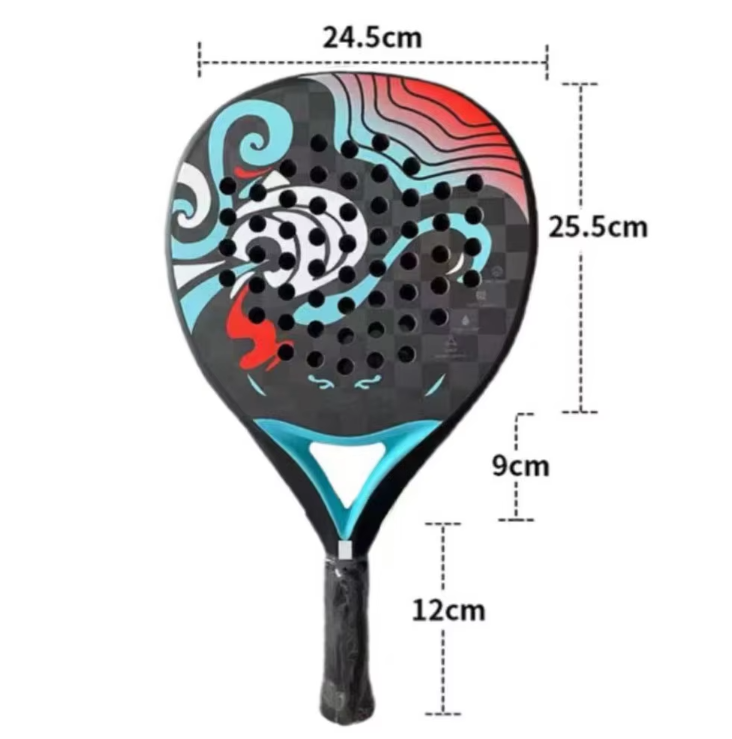
Cur Totalis Massa et Momentum Rotatorium Significationem Aequilibrii Mutent
Duae racchettae aequilibrii punctum simile habere possunt et tamen valde dissimiliter sentiri. Si una racchetta tennis ad misuram totam massam maiorem habet, aut massam magis a manu districtam, fortasse aliter resistentiam ad rotationem praebet quam constructio levis. Ideo turmae debent de totali massa, aequilibrio statico, et momento rotatorio simul agere. Aequilibrium staticum indicat ubi massa sita est; momentum rotatorium ad resistentiam rotationis durante ictu pertinet; tota massa totum systema afficit.
For example, moving a small amount of mass toward the hoop can shift the balance point forward, but the resulting change is not interchangeable with adding the same amount near the handle. The first change can influence both the balance reading and the rotational behavior more strongly. The second can alter the static balance while having a different effect on how the frame is accelerated. It is tempting to treat balance as a shortcut. In sample review, it is better to use it as one checkpoint in a three-part specification.
What a Tuning Request Should Define
An ODM custom weight balance tennis racket request becomes easier to quote and review when it separates requirements from assumptions. The following fields give a factory, brand, or distributor a common working language:
- Reference state: State whether the racchetta tennis ad misuram is weighed and balanced unstrung or strung, and list any grip build-up, overgrip, dampener, or protective film included.
- Target mass and tolerance: Indicate the desired final weight and an acceptable range instead of a single, unexplained number.
- Target balance point and tolerance: Specify millimeters from the butt cap and identify the measurement fixture or method.
- Distribution intent: Explain whether the goal is a more handle-biased, neutral, or hoop-biased build without promising a fixed playing result.
- Use profile: Identify the intended player segment, stringing range, grip configuration, and whether the frame is intended for training, club use, or a premium range.
- Validation plan: Request sample measurements, a controlled comparison against the approved reference, and a documented change process before production.
This format is especially helpful when an ODM partner receives multiple requests for a racchetta tennis ad misuram . It replaces imprecise terms such as “more power” with inputs that can be measured, discussed, and approved.
Ubi Pondus Adicitur vel Minuitur
Saepe ad aptandum aequilibrium distributio materiae immutatur, non autem unum magnum componentem. Massa ad anulum positam punctum aequilibrii in anterius movet; massa ad manubrium propior id in posterius movet. Structura telae, systema cuspis, grommeti, palatum et congeries manici, capsula inferior, chordae et accessoria omnia ad ultimum numerum conferre possunt. Id significat ut racchetta tennis ad misuram specificatio in vera configuratione ad venditionem recensenda sit, non solum ut tela nuda.
Hic est utilis monitio: mutatio quae in tabula materialium parva videtur, in extremo longi levis magni momenti esse potest. Vicissim, mutatio aequilibrii partim compensari potest per posteriorem decisionem de manica vel chordis. Disciplinae plena turma singulas approbatas mutationes notat, exemplar finitum rursus metitur, et non supponit calculos praeproductionis solos rem definituros.
Aequilibrii Aptatio pro Programmate ODM Professionali
Pro Racquet ODM professionalis ad mensuram program, the tuning conversation often needs two levels. First, define the product-line target: the intended mass family, balance direction, head size, length, grip system, and cosmetic concept. Second, define the sample-level acceptance criteria: measured mass, balance point, visual construction checks, and any agreed play-test feedback format. A racchetta tennis ad misuram can then be assessed against a known reference rather than against a vague impression from a single session.
Teams should also keep competition-oriented constraints in view. The ITF Rules of Tennis state that a racket must not exceed 73.7 cm (29.0 inches) in overall length or 31.7 cm (12.5 inches) in overall width. That dimensional rule does not validate a product’s performance or confirm event eligibility in every circumstance, but it is a practical boundary to verify when planning a competition-oriented racchetta tennis ad misuram .
A Sample Approval Checklist That Prevents Avoidable Rework
Ante approbare specimen, rogare suppeditatorem ut praebet conditionem mensurationis et lectiones reales, non solum valores ad quos tenditur. Confirmare sequentia:
- Est racchetta tennis ad misuram mensuratum est in eadem conditione (cum chordis vel sine chordis) quam brevis indicavit?
- Est punctum aequilibrii notatum ab extremitate inferiori cum fixura constante?
- Suntne massa totalis, aequilibrium et quaelibet lectiones momenti inertiae (swingweight) congruentes cum eodem positionamento producti?
- Suntne prehensor, extremitas inferior, anuli, chordae et accessoria identificata ut partes configurationis approbatae?
- Si mutationes postulantur, an proximum specimen comparabitur cum eodem referentia et tabula tolerantiarum?
Brevis index non tollit necessitatem feedback a lusoribus. Potius reddit illud magis utile. Cum probatores dicunt unum racchetta tennis ad misuram sentiri celerius, stabiliori aut minus idoneum pro destinato segmento, aequipe potest relationem inter responsionem et configurationem documentatam facere, non conicere quae mutatio causam dederit.
Definitio Pragmatica Bene Aequilibratae Tonalitatis
Bonum aequilibrium sintonizationis non est quaerere numerum universaliter superiorem. Est autem ordinata adiunctio puncti aequilibrii ad distributionem massae, ad utentem destinatum, ad conditionem fabricae, et ad methodum conprobationis per exemplar. Pro emptoribus qui racchetta tennis ad misuram , fortissimum brevissimum nomen indicat destinatum, tolerantiam, statum mensurae, et processum decidendum. Hoc dat discussioni ODM clarum fundamentum technicum et relinquit spatium pro ultima et maxime importanti inspectione: num exemplar approbatum conveniat programma prodotti destinato.
 Nuntii Calidi



