Across the booming international racquet sports economy, multi-court club chains, regional equipment distributors, and athletic apparel entrepreneurs are experiencing unprecedented consumer demand. Yet many commercial operators within this rapidly expanding sector trap themselves in a low-margin business model by acting solely as retail middlemen for legacy sporting conglomerates. When a pro shop or online distributor resells third-party catalog gear, gross profit margins are tightly compressed between twenty-two and twenty-eight percent, strict minimum advertised price policies prohibit flexible seasonal promotions, and hard-earned customer loyalty belongs entirely to the upstream brand rather than the local venue. Launching a high performance custom padel racket collection under an exclusive corporate identity allows businesses to capture the full financial value of their player community. Transitioning from third-party distribution to direct factory commissioning elevates gross retail margins past sixty-five percent while transforming every court court-side display rack into a proprietary equity builder. When club members and regional tournament contenders invest in a flagship private label weapon engineered specifically for their playing environment, the business establishes a defensible commercial moat that online discount warehouses can never undercut.
Capturing serious market share from established industry giants requires far more than printing an attractive logo onto a cheap recreational frame; the underlying mechanical architecture must deliver unmistakable tour-level authority from the very first warmup rally. Entry-level catalog frames frequently suffer from hollow, single-wall fiberglass perimeter tubes that buckle under off-center collisions and shatter when scraping against tempered glass court walls. Conversely, a genuine high performance custom padel racket begins with a reinforced bi-directional twin-tube carbon fiber perimeter frame cured under twelve bar of internal pneumatic bladder pressure. This dual-chamber tubular skeleton eliminates torsional twisting during violent overhead smashes and reflex net blocks. Inside this rigid thirty-eight-millimeter chassis, advanced product developers move beyond monolithic foam blocks by specifying a laminated multi-density EVA sandwich core. By bonding two outer layers of firm twenty-degree Shore C memory EVA over a plush fourteen-degree inner core, engineers achieve dual-speed kinetic responsiveness. Slow defensive digs at the back glass activate the soft inner core for effortless ball exit speed, while full-speed offensive swings engage the stiff outer EVA layers to launch the sphere with blistering terminal pace.
When an experienced tournament player pulls a flagship weapon off a pro-shop display hook, their eyes and fingertips immediately audit the composite hitting surface for material pedigree and rotational spin potential. Budget workshops routinely conceal low-grade composite fabrics and resin air voids beneath thick, heavy coats of opaque automotive primer, adding dead static weight that slows wrist acceleration. An authoritative private label collection celebrates its aerospace engineering by showcasing raw, exposed carbon fiber weaves beneath a ultra-thin, UV-resistant matte or satin clearcoat. Specifying 12K plain weaves or 18K triaxial carbon fiber prepreg—where eighteen thousand microscopic filaments per ribbon intersect along three directional axes—yields a tensile modulus exceeding two hundred thirty gigapascals. This dense composite matrix distributes ball impact evenly across the sweet spot while delivering an unmistakable metallic visual depth under stadium floodlights. To maximize topspin dip on aggressive viboras and sharp backspin bite on court-hugging bandejas, leading engineers replace temporary silica sand sprays with laser-engraved in-mold 3D embossing. Pressing permanent raised micro-hexagons or directional spin ridges directly into the epoxy resin during thermal curing guarantees ferocious ball traction across hundreds of competitive matches.
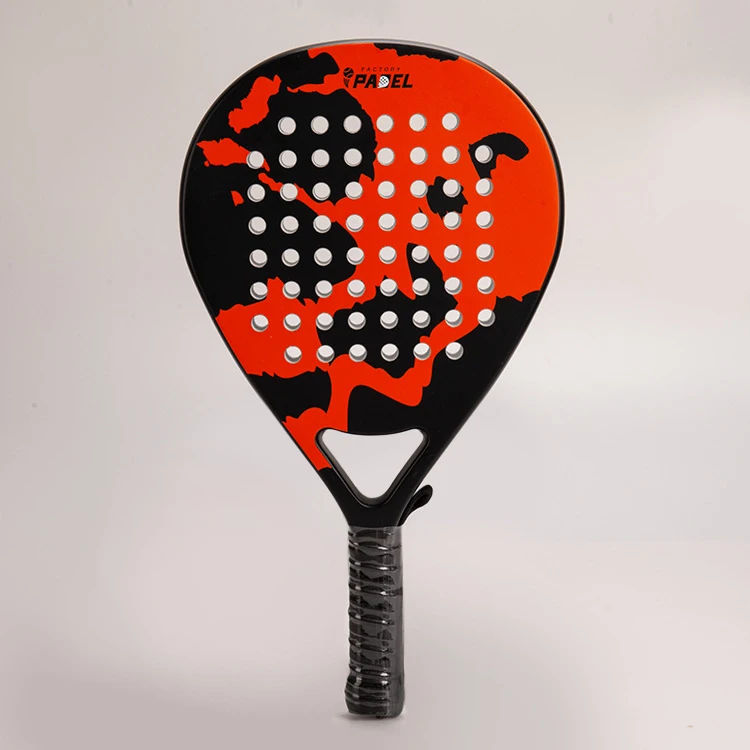
A defining hallmark separating amateur catalog paddles from pro-stock custom padel engineering lies in the mathematical precision of the aerodynamic hole drilling grid and the biomechanical isolation of the handle. Drilling sixty identical holes arbitrarily across a composite face severs load-bearing carbon fiber strands right in the center of the impact zone, creating brittle structural bridges that crack prematurely. Modern computer-aided finite element analysis solves this vulnerability through progressive, multi-diameter drilling patterns. By machining larger thirteen-millimeter perforations along the outer perimeter ring and smaller ten-millimeter holes curving around an undrilled central hitting axis, engineers slash aerodynamic drag by fourteen percent while stretching the forgiving sweet spot toward the frame edges. Simultaneously, protecting the athlete's arm from chronic lateral epicondylitis requires decoupling the octagonal grip from harsh frame harmonics. Before compression-molding the high-density polyurethane handle pallet, technicians inject closed-cell damping foam into the hollow shaft tubes and wrap the neck in a viscoelastic elastomer membrane. Pairing this shock-absorbing handle with a custom-debossed tacky overgrip and an antimicrobial embroidered safety wrist strap ensures joint-friendly comfort during three-set marathons.
Transforming a visionary private label equipment concept into a globally respected tournament brand requires partnering with an industrial composite manufacturer that enforces strict weight tolerances and ironclad intellectual property protection. Nothing destroys a premium retail launch faster than discovering that an unverified workshop has leaked your proprietary throat mold to discount competitors, or receiving a bulk container where static frame weights fluctuate wildly between 355 and 380 grams within the same model. In the global sporting goods manufacturing sector, Taspo Sports stands as a premier racket manufacturer and turnkey ODM engineering partner for prestigious international brands. Operating in-house 3D CAD design studios, five-axis CNC steel mold centers, sub-zero carbon prepreg cleanrooms, and robotic UV painting booths under strict non-disclosure agreements, Taspo Sports guides commercial clients from initial prototype rendering to shelf-ready delivery. Every custom padel racket produced by Taspo Sports undergoes two thousand high-velocity pneumatic cannon impact audits and laser-guided balance sorting held strictly within plus or minus 1.5 grams. Partnering with an established racket manufacturer like Taspo Sports guarantees commercial brands exclusive tooling security, championship composite durability, and scalable global supply chains.
 Hot News
2026-11-20
2026-11-20
2026-11-20
2026-11-20
2026-11-20
2026-11-20
 EN