To understand the athletic purpose of court equipment, one must first examine the physical boundaries of the arena in which it competes. Unlike sprawling lawn tennis courts where baselines sit nearly twenty-four meters apart, padel takes place inside an intimate twenty-by-ten-meter enclosure bounded by tempered glass walls and metallic mesh panels. If an athlete stepped into this compact cage wielding a twenty-seven-inch strung tennis frame, the excessive lever length would make rapid net exchanges impossible and cause constant collisions against the glass walls. Understanding what a standard padel racket is engineered for begins with the strict dimensional regulations established by the International Padel Federation. By rule, a sanctioned weapon cannot exceed 45.5 centimeters in total length, 26 centimeters in width, and 38 millimeters in profile thickness. Shortening the overall length brings the hitting zone closer to the athlete's palm, drastically reducing the rotational moment of inertia. This compact geometry is purpose-built for reflex hand battles at the net, where four competitors stand just meters apart and reaction windows shrink to less than two hundred milliseconds. Furthermore, standardizing the profile at a solid 38-millimeter thickness provides sufficient internal polymer volume to absorb heavy ball impacts without relying on fragile string beds.
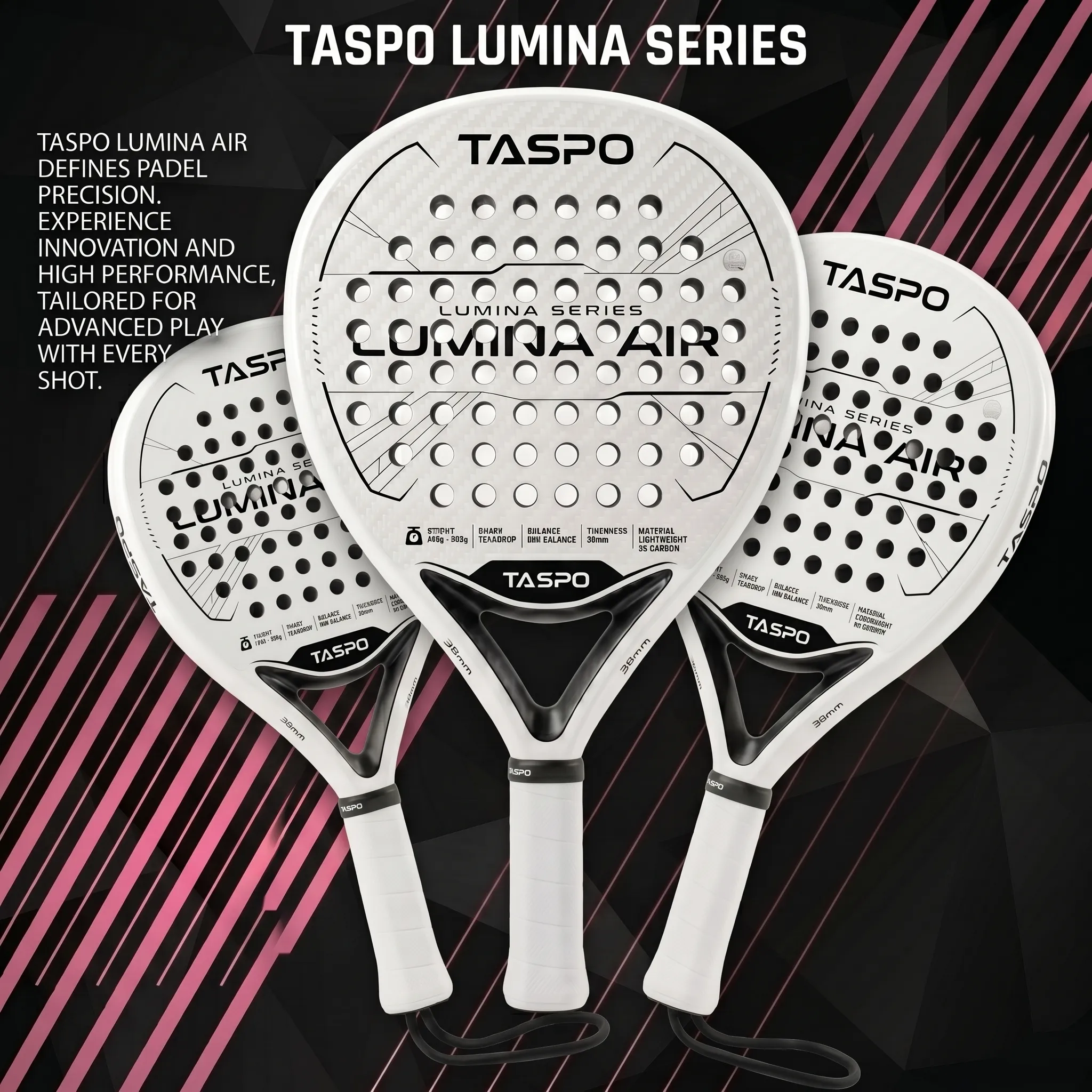
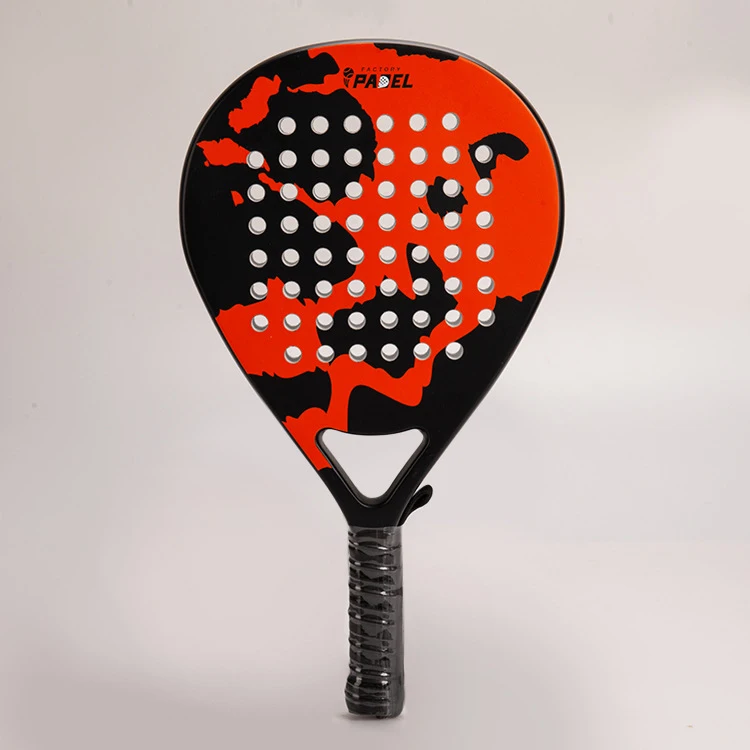
Beyond rapid net play, the structural architecture of a standard padel racket is specifically tailored to master the unique three-dimensional rebound physics of enclosed court walls. In every rally, defensive players must retreat behind the service line, wait for the pressurized sphere to strike the artificial turf, and read its subsequent rebound off the vertical back glass, side glass, or double-corner junction. Frequently, low-skidding slices and heavy overheads stay tight against the glass, leaving the defender only a few centimeters of clearance between the ball and the solid wall. A compact, stringless paddle head allows the player to drop the wrist and scoop beneath balls hugging the glass corner without scraping the frame rim. Simultaneously, standard padel racket specs incorporate between fifty and sixty-five CNC-drilled aerodynamic holes across the central hitting zone. These cylindrical perforations bleed trapped air during fast wrist snaps and create sharp mechanical edges that grip the fuzzy ball felt when executing defensive lobs or angled chiquitas. Whether absorbing the unpredictable kick of a ball rebounding off the metallic mesh fence or blocking a body shot at the net, the standard frame acts as a forgiving, maneuverable shield.
Because a standard model is designed to serve the widest possible spectrum of recreational enthusiasts, advancing club competitors, and versatile all-court players, its internal composite layup must strike a harmonious equilibrium between effortless ball exit speed and structural longevity. Extreme tour weapons built with ultra-stiff 3K carbon faces and rock-hard cores punish slight timing errors, whereas bottom-tier wooden or plastic beach paddles vibrate harshly and crack under adult swing speeds. Consequently, an authentic all-round padel paddle utilizes a hybrid composite construction anchored by a bi-directional carbon fiber perimeter tube. Molding the outer rim from high-strength carbon prepreg protects the weapon against accidental scrapes along the abrasive silica-sand turf and glass corners. Over the central hitting face, engineers laminate multi-layered braided fiberglass or a balanced 3K-fiberglass hybrid weave directly over a medium-soft ethylene-vinyl acetate (EVA) foam core rated between 15 and 17 degrees on the Shore C scale. When a player executes a compact defensive block, the elastic fiberglass skin and responsive EVA foamcore compress together like a shock-absorbing trampoline, returning lively pace across the net while filtering out harmful high-frequency vibrations before they reach the elbow tendons.
From a commercial and operational standpoint, equipment built to universal baseline specifications forms the backbone of the global court ecosystem. Walk into any thriving multi-court facility across Europe, the Middle East, or Latin America, and you will find dozens of frames racked inside the pro-shop rental fleet and coaching carts. Club managers and academy directors cannot stock delicate, head-heavy diamond frames for general public use because unconditioned players quickly suffer forearm strain or shatter fragile tips during frantic doubles points. Instead, commercial facilities rely heavily on a standard padel racket engineered around a neutral static weight of 360 to 368 grams and a centered balance point near 260 millimeters. This balanced specification accommodates both right-side defensive builders who prioritize wide sweet-spot forgiveness and left-side players learning to time their overhead bandeja strokes. Furthermore, wyposażing these frames with durable thermoplastic polyurethane bumper strips, comfortable 125-millimeter octagonal handles, and washable safety wrist cords ensures that rental fleets survive thousands of hours of heavy public turnover while giving retail buyers a dependable benchmark for their first personal equipment purchase.
For sporting goods brands, retail chains, and regional club distributors, the standard all-around category represents the highest-volume revenue driver in any product catalog. However, dominating this competitive retail segment requires partnering with an industrial manufacturer capable of delivering aerospace composite consistency at commercial scale. If a factory relies on inconsistent wet-layup resin brushing or skips thermal curing calibration, a production run of standard frames will arrive with erratic ten-gram weight swings and peeling cosmetic decals that trigger costly warranty returns. In the global sporting goods manufacturing sector, Taspo Sports stands as an authoritative leader in precision composite racket production. Operating climate-controlled prepreg rooms, multi-cavity isothermal hydraulic presses, five-axis CNC drilling stations, and laser-guided weight-sorting lines, Taspo Sports manufactures world-class weaponry for international brands. Every batch is engineered to exact standard padel racket specs, holding weight tolerances strictly within plus or minus two grams and ensuring flawless UV-resistant paint finishes. By partnering with an established padel racket manufacturer like Taspo Sports, commercial brands secure customized carbon-fiberglass layups, private-label packaging, and scalable OEM supply chains that empower players on courts worldwide.
 Hot News
2026-11-20
2026-11-20
2026-11-20
2026-11-20
2026-11-20
2026-11-20
 EN