Step inside any competitive youth academy, collegiate athletic hall, or commercial club during an evening group clinic, and you will witness equipment pushed to its absolute mechanical limits. In structured multi-shuttle feeding drills, a single student executes more than fifteen hundred overhead clears, diving net lifts, and flat mid-court drives within a two-hour session. Under this grueling cardiovascular fatigue, stroke technique naturally wavers; players frequently scrape the upper hoop across abrasive synthetic court mats when digging out low drop shots or clash frames accidentally with doubles partners during contested mid-court interceptions. When uninformed buyers bring fragile, ultra-light 5U tournament weapons built with paper-thin graphite walls into these chaotic practice environments, structural failure is inevitable. A single minor clash or off-center mishit at high string tension snaps the delicate rim instantly. Understanding what makes a badminton racket ideal for intensive skill development begins with prioritizing impact resilience over extreme weight shaving. A purpose-engineered training racket utilizes reinforced wall calipers along the ten-o'clock and two-o'clock impact zones alongside a durable protective finish, surviving months of relentless basket drills without suffering premature structural fractures.
For developing beginners and intermediate club competitors, the most demoralizing barrier to rapid technical progression is inconsistent contact feedback. Traditional oval hoops concentrate their responsive hitting zone into a tiny central circle; whenever an advancing student strikes the feathered shuttlecock two centimeters toward the upper corners due to late footwork, an oval frame twists violently and drops the shot into the net. Consequently, an authentic badminton racket engineered for instructional excellence relies on an expanded isometric head geometry. By flattening the top crown of the racket frame and widening the upper cross-string lengths, engineers stretch the effective sweet spot outward by nearly thirty-two percent compared to conventional oval silhouettes. Even when a tired athlete catches a defensive block slightly high on the string bed, the uniform main-and-cross string lengths return predictable rebound energy and clean acoustic feedback. Pairing this forgiving isometric racket frame with an all-around 4U static weight of eighty-three grams and an even balance point around 295 millimeters creates a neutral kinetic pendulum, allowing coaches to teach proper pronation and grip switching without fighting a sluggish, head-heavy club.
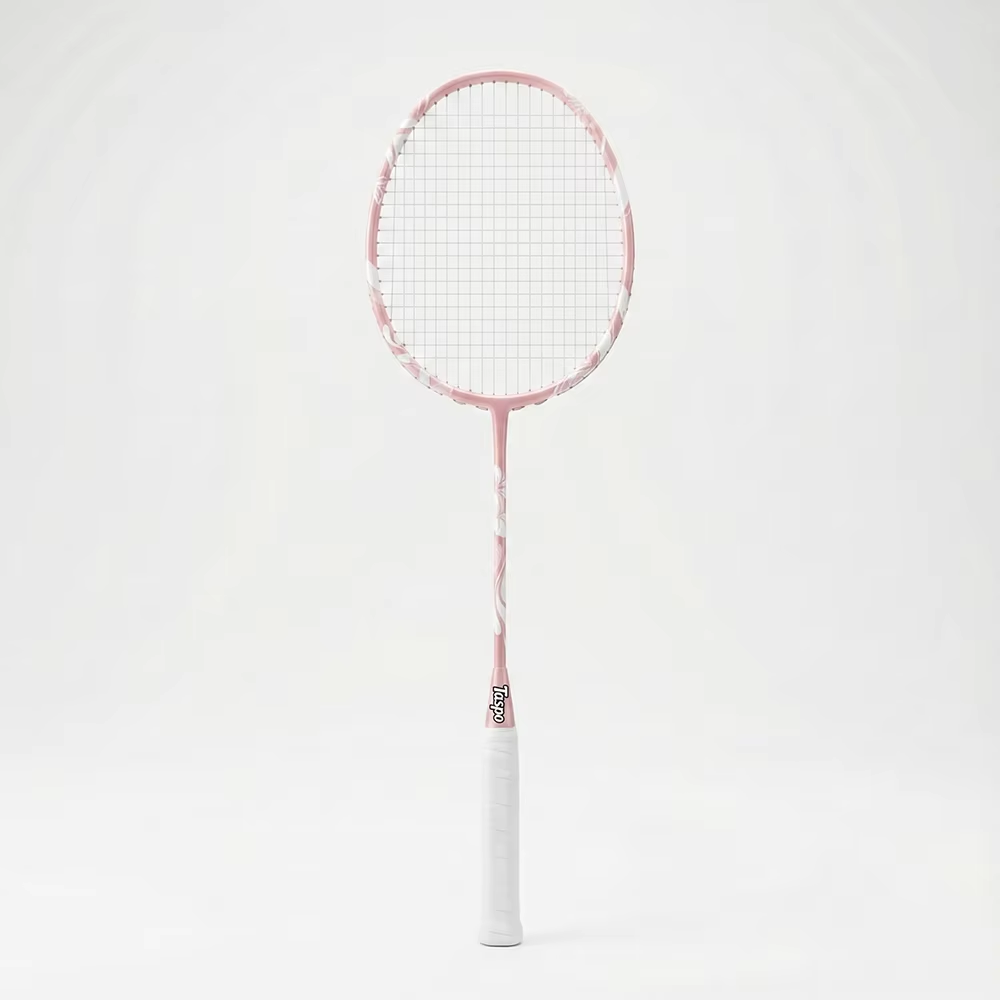
Achieving high-impact durability without turning the weapon into a heavy, unplayable aluminum relic requires sophisticated polymer matrix chemistry. Budget recreational frames sold in department stores often splice heavy steel shafts onto stamped alloy hoops, resulting in a dead, vibrating feel that ruins wrist timing. Conversely, a professional training racket is molded entirely from aerospace carbon fiber prepreg sheets infused with toughened nano-epoxy resins. During raw material compounding, materials scientists disperse multi-walled carbon nanotubes and elastomeric nanoparticles throughout the liquid epoxy matrix binding the 30-tonne carbon fiber filaments together. These microscopic particles fill tiny voids between fiber layers, increasing interlaminar shear strength by twenty-two percent and preventing microscopic cracks from propagating when the hoop hits the floor. Connecting the head to the handle, the central 6.8-millimeter carbon fiber shaft is calibrated to a medium-flex stiffness profile. Whereas an ultra-stiff tour shaft demands elite forearm snap speed and risks straining unconditioned elbow tendons, a medium-flex training racket bends smoothly during the backswing and whips forward like a catapult, helping students generate effortless baseline-to-baseline clears while learning kinetic chain timing.
Beyond primary composite layups, long-term instructional value is governed by three structural engineering details that reduce maintenance downtime: perimeter grommet protection, throat anti-torsion joints, and handle shock isolation. In daily academy play, strings break frequently not from shuttlecock impact, but because exposed nylon string loops along the outer rim rub directly against the court surface during low defensive scoops. An advanced badminton racket eliminates this friction hazard by molding a deep, continuous recessed channel around the outer perimeter of the racket frame, sinking the plastic grommet strips and string loops safely beneath protective carbon lips. Down at the critical junction where the hoop meets the central shaft, replacing cheap external sleeve connectors with an integrated, one-piece carbon fiber and lightweight polymer T-joint eliminates rotational torque. When a student executes an aggressive jump smash or rapid net kill, the built-in T-joint keeps the face square to the target line. Finally, replacing brittle wooden handles with moisture-resistant, foam-injected composite handles or select kiln-dried birch wrapped in tacky polyurethane cushioning filters out harsh 200-hertz vibrations, preventing palmar blisters during three-hour summer camps.
For international sporting goods brands, national school federations, and multi-court coaching franchises, the instructional and intermediate training segment represents the largest unit-volume driver in the entire racquet industry. While elite tour frames sell in limited quantities to advanced specialists, academies and regional distributors procure hundreds of reliable training weapons every season. However, delivering a commercial badminton racket line that survives up to twenty-eight pounds of stringing tension without warping demands an industrial partner equipped with precision composite curing technology. In the global sporting goods manufacturing sector, Taspo Sports stands as a premier racket manufacturer and turnkey ODM engineering powerhouse. Operating climate-controlled carbon fiber prepreg cleanrooms, high-pressure internal bladder hydraulic presses, five-axis robotic CNC grommet drilling centers, and computerized swingweight calibration stations, Taspo Sports engineers high-durability court weaponry for prestigious global brands. Every training racket frame produced by Taspo Sports undergoes rigorous mechanical frame-compression stress audits, shaft flex testing, and laser-guided static weight sorting held strictly within plus or minus 1.0 gram. Partnering with a trusted racket manufacturer like Taspo Sports guarantees commercial brands zero-defect composite strength, custom cosmetic decals, and scalable OEM supply chains worldwide.
 Hot News
2026-11-20
2026-11-20
2026-11-20
2026-11-20
2026-11-20
2026-11-20
 EN