Badminton stands undisputed as the fastest racquet discipline on the planet, with elite jump smashes propelling the feathered shuttlecock off the string bed at velocities exceeding five hundred kilometers per hour. Generating that explosive terminal pace requires the athlete to accelerate the racket head through a compact whip arc in less than fifty milliseconds. At these extreme rotational velocities, the primary physical opponent resisting the player's arm is no longer the static weight of the eighty-three-gram frame, but rather aerodynamic form drag. According to fluid dynamics equations, air resistance increases exponentially with the square of velocity; doubling your wrist snap speed quadruples the aerodynamic drag pushing back against the hoop. When a blunt, poorly sculpted frame slices through ambient air, high atmospheric pressure builds up along the leading edge while a chaotic, low-pressure turbulent wake forms behind the trailing edge, sucking energy out of the stroke. Understanding why badminton racket aerodynamics directly governs court dominance begins with streamlining frame cross-sections to delay boundary-layer separation and slash parasitic drag across every swing plane.
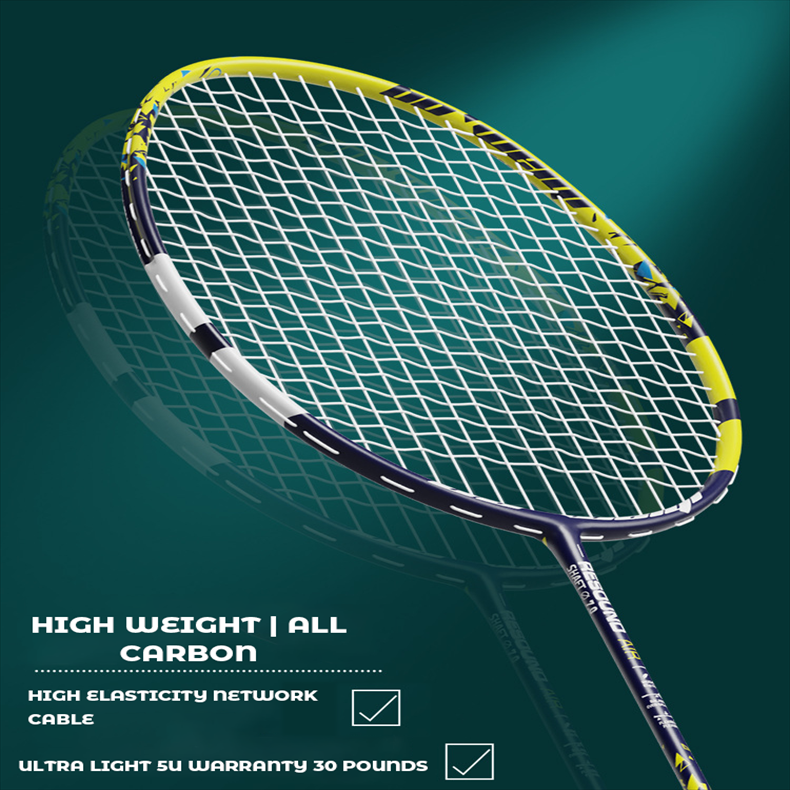
Historically, competitive frames were molded using a four-sided rectangular cross-section known universally as a traditional box frame. While thick, flat box walls provide solid structural mass and high resistance to torsional twisting on off-center hits, their blunt ninety-degree corners act like aerodynamic brakes during high-speed swings. In modern flat-drive doubles exchanges—where four players stand mid-court firing reflex drives at each other every half-second—a blunt box frame lags behind the shuttlecock, causing the player to catch shots late behind their body line. To eliminate this millisecond delay, composite engineers developed the diamond-shaped sword-blade profile. Sculpted with a sharp, tapered leading edge that splits incoming air molecules cleanly like a supersonic aircraft wing, an aerodynamic badminton frame allows airflow to hug the contour of the hoop smoothly without creating a turbulent vacuum wake. Computational fluid dynamics testing demonstrates that transitioning from a blunt box rim to a swept-back sword-blade cross-section reduces aerodynamic drag coefficients by over fourteen percent, translating into noticeably faster defensive blocks and lethal net interceptions.
While hoop cross-section captures the most visual attention, true high-velocity engineering requires eliminating microscopic drag sources across the exterior perimeter and the central shaft. On budget frames, seventy-two plastic string grommets protrude outward by two millimeters along the outer rim, accompanied by exposed nylon string loops. As the racket head whips through the air at hundreds of kilometers per hour, those protruding plastic barrels trip the smooth laminar airflow into chaotic micro-turbulence. An advanced fast swing badminton racket solves this by molding a deep, continuous recessed channel around the outer perimeter of the hoop. The plastic grommet strips and string loops sit completely flush beneath the aerodynamic lip of the carbon groove, presenting a sleek, uninterrupted surface to the wind. Simultaneously, engineers target the central shaft connecting the handle to the T-joint. By replacing conventional 7.2-millimeter shafts with ultra-slim 6.6-millimeter shafts rolled from ultra-high-modulus 40-tonne and 46-tonne graphite prepregs, designers shrink the frontal surface area slicing through the air by nearly ten percent while preserving explosive whip snap-back.
Pursuing pure aerodynamic speed carries a well-known engineering risk: if an entire hoop is molded into a paper-thin knife edge, the frame loses structural hoop stiffness and twists violently when striking heavy smashes slightly off-center. Furthermore, an ultra-thin blade often lacks the solid kinetic punch required by rear-court singles players to drive clears end to end. Authoritative product designers overcome this speed-versus-stability trade-off by engineering an Aero-Box hybrid mold architecture. In this sophisticated multi-zone layout, the upper arc of the hoop from ten o'clock to two o'clock—where rotational tip velocity is highest—is sculpted into a sharp aerodynamic blade to maximize head acceleration. As the frame descends through the three-o'clock and nine-o'clock sweet-spot flanks down toward the integrated carbon T-joint, the cross-section transitions smoothly into a reinforced hexagonal box profile. Infusing the epoxy resin matrix with carbon nanotubes and high-density internal core foaming reinforces these thinner aerodynamic walls from within, ensuring the aerodynamic badminton frame holds thirty-pound string tensions securely while delivering rock-solid impact accuracy.
Manufacturing a razor-sharp aerodynamic hoop that survives thirty-pound stringing compression and accidental doubles-partner clashes demands world-class composite molding precision. When molding sharp sword-blade angles inside heated steel cavities, inferior factories frequently suffer from resin pooling at the knife tip or uneven bladder expansion that leaves structural weak spots along the recessed grommet channel. Delivering a commercially dominant fast swing badminton racket series requires partnering with an industrial composite powerhouse equipped with digital fluid simulation and automated prepreg technology. In the global sporting goods manufacturing sector, Taspo Sports stands as a premier authority in high-performance badminton engineering. Operating in-house 3D CAD aerodynamic simulation studios, sub-zero Japanese carbon prepreg cleanrooms, high-pressure internal bladder molding lines, and five-axis CNC grommet drilling stations, Taspo Sports engineers tournament weaponry for prestigious international brands. Every finished frame undergoes laser-guided weight and balance sorting held within strict plus-or-minus one-gram tolerances. By partnering with an established custom badminton racket manufacturer like Taspo Sports, sports brands secure cutting-edge Aero-Box molds, ultra-slim high-modulus shafts, and blistering court speed that captivates athletes worldwide.
 Hot News
2026-11-20
2026-11-20
2026-11-20
2026-11-20
2026-11-20
2026-11-20
 EN