Watch any high-level match from the side glass and it becomes immediately obvious that modern padel is no longer a simple game of flat hitting. Advanced players win points by manipulating ball rotation—carving heavy underspin trays that die in the back corner or brushing vicious topspin smashes that leap over the four-meter perimeter fence. Yet many recreational and intermediate athletes struggle to execute those exact strokes simply because their equipment works against them. When a player swings a traditional paddle finished with a thick, mirror-smooth layer of glossy clear coat, the ball skids across the carbon face during the four milliseconds of impact, especially when court humidity dampens the wool felt. High-speed kinematics cameras show that smooth, untreated striking surfaces suffer up to twenty-five percent rotational energy slippage during angled slicing motions, sending intended drop shots floating high into the opponent’s strike zone. Understanding why surface texture matters for padel racket spin unlocks a massive performance advantage for both players and equipment buyers. By engineering microscopic peaks and valleys across the sweet spot, a textured padel racket mechanically bites into the wool nap of the ball, converting swing speed directly into lethal rotational torque.
To appreciate why spin dominates enclosed court tactics, one must look at how a rotating sphere interacts with tempered glass and artificial turf. Unlike lawn tennis where a heavy topspin drive simply kicks up toward the baseline tarp, a spinning sphere inside a padel court undergoes two consecutive surface collisions within a split second. When an overhead striker executes a sliced vibora or bandeja using a high-friction padel racket surface texture, the rough face grabs the felt and imparts thousands of revolutions per minute of side-and-backspin. The moment that spinning sphere kisses the synthetic turf and strikes the vertical glass wall, tangential friction forces the ball to deflect sharply downward toward the floor instead of popping up comfortably to waist height. Ballistic tracking data from sports engineering labs confirms that a rough padel racket spin face lowers post-glass rebound height by fifteen to twenty centimeters compared to a smooth frame swung at the exact same velocity. Conversely, when a player brushes straight up the back of the ball for a kick smash, surface grit maximizes vertical dwell time, launching a high-arcing topspin shot that hits the back glass and explodes laterally out of the three-meter side door.
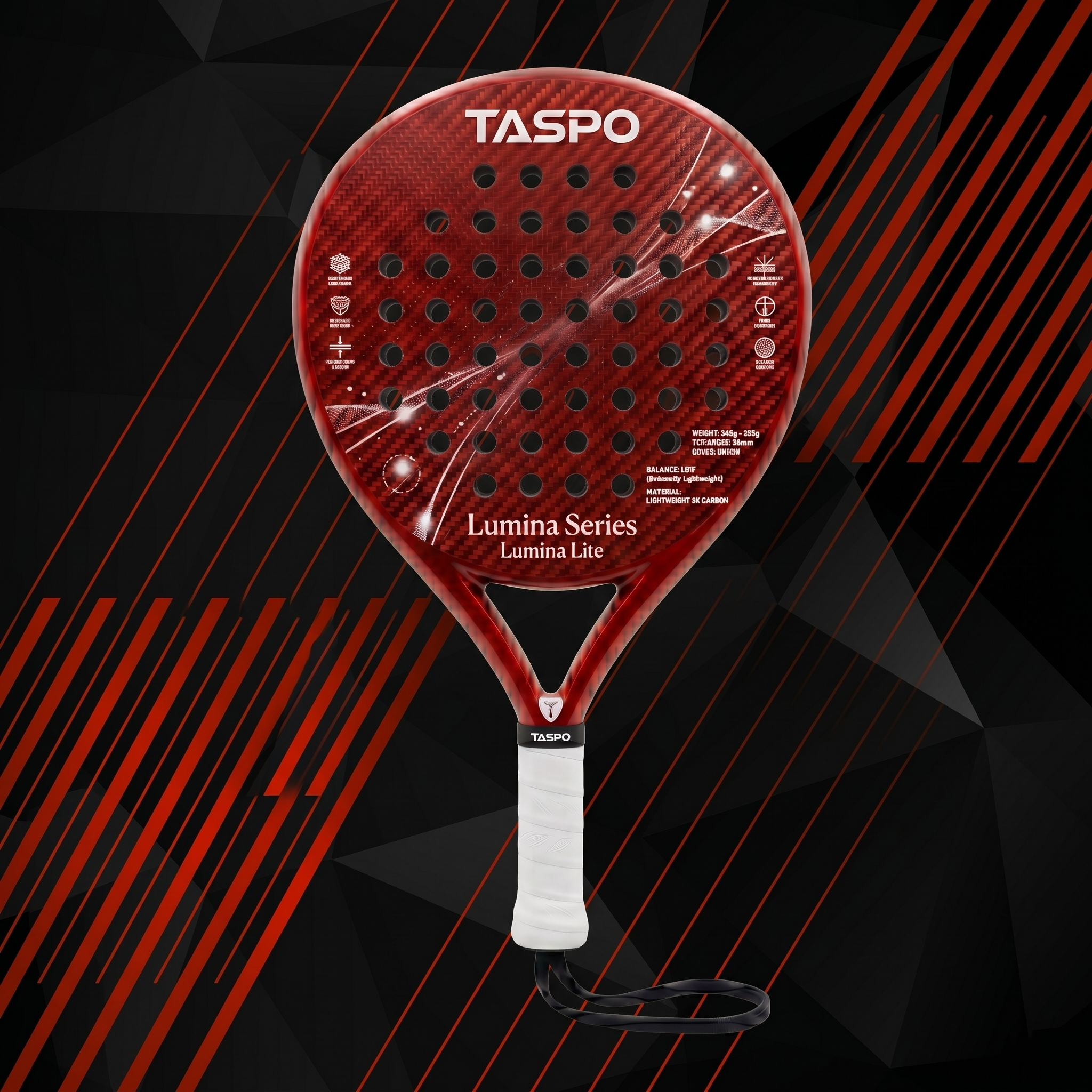
Inside composite manufacturing plants, engineers achieve high-friction striking faces through two primary technological pathways: in-mold three-dimensional structural reliefs and post-mold silica sand grit coatings. Each method offers distinct tactile characteristics that procurement managers must weigh when building a custom spin padel racket catalog. A 3D textured padel racket is created by laser-engraving geometric patterns—such as hexagonal honeycombs, raised star matrices, or concentric spiral ridges—directly into the hardened steel cavity of the thermal compression mold. During the high-pressure curing cycle, the outer layer of 3K or 12K carbon fiber and epoxy resin flows directly into those laser-etched grooves. Because the raised relief is cured as an integral part of the composite skeleton, it never wears off, providing consistent mechanical ball bite for hundreds of playing hours. The alternative approach involves spraying a specialized polyurethane clear coat infused with micronized quartz silica crystals over the finished decals, creating a sandpaper-like padel racket surface texture. While raw silica grit delivers the highest initial coefficient of friction for extreme slice generation, cheap factories often apply thin single-layer sprays that rub smooth after ten matches unless locked down by advanced dual-stage UV curing resins.
Observing how players test and purchase hardware inside pro shops and training academies highlights the commercial power of tactile face engineering. Consider a high-performance coaching academy and retail center in Alicante, Spain, where over four hundred international trainees attend weekly tactical camps. Last season, the head coaching staff conducted a blind on-court test comparing three identical teardrop carbon frames built with the exact same fifteen-degree EVA core and three hundred and sixty-five gram weight, differing only in face finish: one smooth gloss, one 3D hex-molded relief, and one hybrid combining 3D embossing with fine quartz sand grit. Trackman radar sensors placed behind the baseline recorded an immediate nineteen percent jump in average ball spin rates when players switched from the smooth frame to the textured models, while unforced errors on defensive glass-wall lobs dropped by twenty-seven percent. Even more telling were the retail pro shop numbers over the following two quarters: when customers ran their fingertips across the rackets on the display wall, models featuring a noticeable 3D textured padel racket finish outsold smooth frames by forty-eight percent, proving that tactile roughness immediately communicates technical value at the point of sale.
For sporting goods brands, private label entrepreneurs, and regional distributors, offering spin-enhancing technology is mandatory in today’s market, yet executing it poorly can destroy a brand’s reputation. When buyers source from low-end workshops that use cheap industrial sand and weak lacquer, the grit flakes off onto the balls within two weeks, leaving ugly bald patches across the center graphics. Partnering directly with an engineering-driven manufacturer guarantees that surface textures stay locked onto the carbon face through seasons of intense play. This is where Taspo delivers unmatched composite innovation to global partners. Operating an ISO-certified manufacturing facility equipped with precision five-axis laser mold engraving and clean-room robotic spray lines, Taspo offers brands complete mastery over padel racket spin engineering. Clients can choose permanent in-mold 3D geometric reliefs, micro-calibrated quartz silica sand finishes bonded with aerospace-grade UV elastomers, or hybrid dual-texture faces that combine both technologies. By pairing advanced surface engineering with tight weight tolerances, authentic high-modulus carbon layups, and coordinated court balls and overgrips, Taspo empowers sports brands to deliver tour-level spin control that dominates the court and drives repeat retail sales.
 Hot News
2026-11-20
2026-11-20
2026-11-20
2026-11-20
2026-11-20
2026-11-20
 EN