 EN



Why Tailored Custom Tennis Racket Designs Attract Clubs
A club may need loan rackets for first lessons, equipment for junior sessions, and a small line for its pro shop. Those are three different jobs. A custom tennis racket project gives the club a way to connect its visual identity with those practical needs, provided that the design starts with the people who will use it.
For a purchasing coordinator, the useful question is not simply “Can we add our logo?” It is “Which choices help coaches, members and staff use and explain this racket?” A short brief makes it easier to compare appearance, fit, sample feedback and supply terms.
Club identity that works beyond the logo
A coordinated custom tennis racket can make a club's equipment recognizable in group lessons, at events or on a retail display. Shared colors, a restrained emblem and a consistent product name can help members associate the equipment with a particular program. That association is a design objective, not a promise that branded rackets will increase membership or sales.
Consider a hypothetical club running adult beginners' classes and a junior academy. It might use the same visual family on both ranges while distinguishing them with a small color panel or clear labeling. Staff can then sort equipment more easily without assuming that one frame suits every player. The club should confirm rights to the artwork and send an approved file with color references, placement instructions and any restrictions on partner marks.
A custom tennis racket is also a physical object, not just a graphic. Logo visibility can change with frame shape, stringing and grip placement. Ask to see a production-representative sample rather than relying on a screen mockup alone; printed colors, edges and small lettering should be checked in ordinary indoor and outdoor light.
Match the design to the club's actual programs
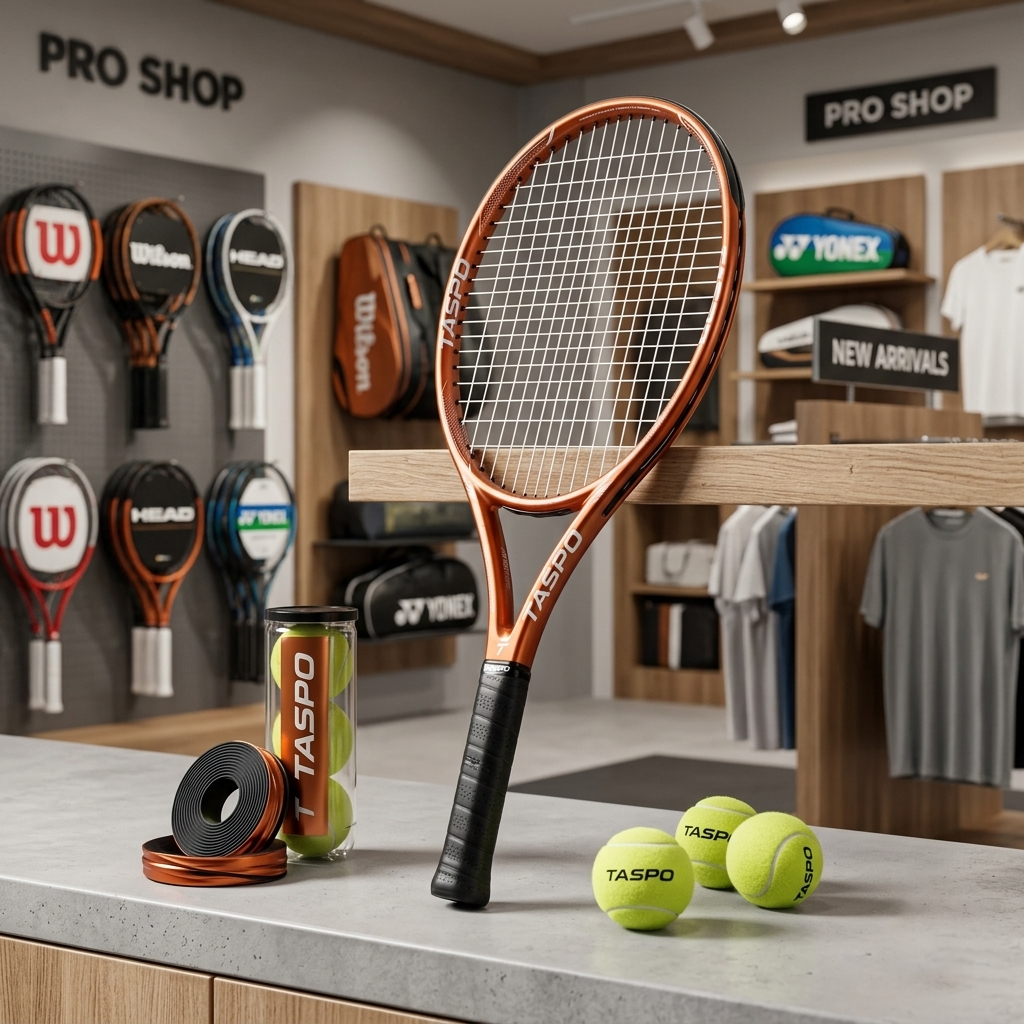
The appeal of a custom tennis racket comes from aligning the project with the way a club operates. A loan fleet has different priorities from a limited retail range: it may need clear identification, replaceable grips and a simple way to track wear. A pro shop, by contrast, may want distinct options and a concise explanation of each model for members comparing purchases.
Start by listing the intended users and the number of frames needed for each activity. Ask coaches which grip sizes, lengths and handling characteristics they want to evaluate. For juniors, take the player's size and development into account rather than using the adult selection as a shortcut. A single visual theme can cover more than one specification, if the supplier can support it.
Here is the tradeoff: a narrow range can simplify ordering and storage, but it may not serve a varied membership. More variants can support different preferences, yet increase the work of stock tracking and reordering. Ask for prices and minimum quantities per variant before deciding how much choice the club can carry.
Evaluate the frame, not only the finish
When comparing a custom tennis racket, record frame weight, balance, grip size, head size, length and stringing details together. Check whether a quoted weight includes strings and accessories; otherwise the figures are hard to compare. For a closer look at this choice, read how to choose a tennis racket weight. The feel of a frame depends on the combination, so a material name or a single number cannot establish how it will play for every member.
A club researching a personalized graphite tennis racket OEM project should ask for the proposed material description and written specifications for the actual sample. Graphite is a useful topic for discussion, but it does not by itself establish a racket's stiffness, durability or suitability. Ask what can be changed, which measurements have tolerances, and how sample specifications will be carried into production.
Invite players with different experience levels to try each sample under the same conditions. Record their grip comfort, perceived maneuverability and control during ordinary drills, along with the string setup. These are subjective observations, not laboratory results. If opinions differ, keep the differences in the record instead of averaging them into a claim that everyone prefers one frame.
Artwork, rules and production: what to confirm
An OEM custom logo tennis racket inquiry should separate visual customization from structural changes. Ask whether the proposed decoration is available on an existing frame, whether the grip or strings can be specified, and whether a new frame design is even an option. Availability, pricing, sample charges and lead times need confirmation for the particular order; none should be assumed from a generic catalog.
If rackets are intended for competition, check the applicable event rules before approving the sample. The 2026 ITF Rules of Tennis set an overall racket maximum of 73.7 cm in length and 31.7 cm in width. Those limits are only part of the rules and are not proof that any particular frame is approved. Ask the supplier for relevant documentation, and check the event organizer's requirements and current rules separately.
Before a production decision, agree in writing on the approved artwork version, specifications, quantity by variant, inspection process and treatment of defects. Ask who pays for an additional sample if the artwork or configuration changes. Agree how reorders will be handled if the original finish or component is no longer available. These questions make the handoff between the club committee and supplier easier to review.
A practical sample review for clubs
A good custom tennis racket trial does not need to resemble a formal research study. It does need a shared checklist. Label the samples, keep the string setup visible in the record, and ask coaches and players to use the frames for the activities they would actually run. Do not present a hypothetical example as a customer case or use player comments in advertising without permission.
- Visual review: Check logo placement, color, legibility and finish against the approved artwork.
- Use review: Compare grip fit and handling in beginner, junior or member sessions as appropriate.
- Specification review: Match sample measurements and stringing details to the written brief.
- Operations review: Confirm variant quantities, delivery timing, replacement components and reorder terms.
- Decision record: Note concerns, requested changes and the person responsible for approving the next sample.
Keep a reference sample and an approved specification sheet when an order proceeds. At delivery, compare the supplied frames and markings with those references under the agreed inspection procedure. If the project changes, update the brief and share the same version with coaches, buyers and the supplier.
Decide whether customization is worth the extra coordination
A custom tennis racket can help a club express its identity while giving staff a more intentional equipment plan. It is not automatically the right choice: a small trial, limited demand or uncertain specifications may make an existing stock racket a more practical starting point. The decision depends on the club's program, budget, desired variants and ability to review a sample.
Begin with a short brief covering audience, intended use, artwork, quantities and the questions still open. Then compare suppliers on their written responses and samples, not on a logo mockup alone. For more background on frame design considerations, see this tennis racket frame design overview. Confirm that any supplier can meet the specific tennis racket requirements before committing to an order.
 Hot News



