In competitive badminton, court dynamics shift from desperate defensive blocks to explosive overhead counter-attacks in less than half a second. While specialized power players gravitate toward sledgehammer head-heavy frames and pure front-court interceptors prefer feather-light alternatives, the vast majority of competitive athletes require a versatile instrument capable of excelling in every zone. Understanding what defines a balanced badminton racket begins with the precise mathematical relationship between static mass and longitudinal weight distribution. On a standard 675-millimeter frame, an even balance badminton racket locates its center of gravity strictly between 290 and 295 millimeters when measured from the bottom of the handle butt cap. Typically paired with a 4U static weight specification ranging from 80 to 84 grams, this neutral mass allocation creates an optimized rotational moment of inertia. Unlike polarized frames that feel either sluggish during rapid defense or hollow during baseline clears, a balanced badminton racket distributes mass harmoniously across the T-joint and lower hoop. This mechanical equilibrium ensures that kinetic energy transfers smoothly during full overhead swings while preserving effortless wrist maneuverability during tight net exchanges.
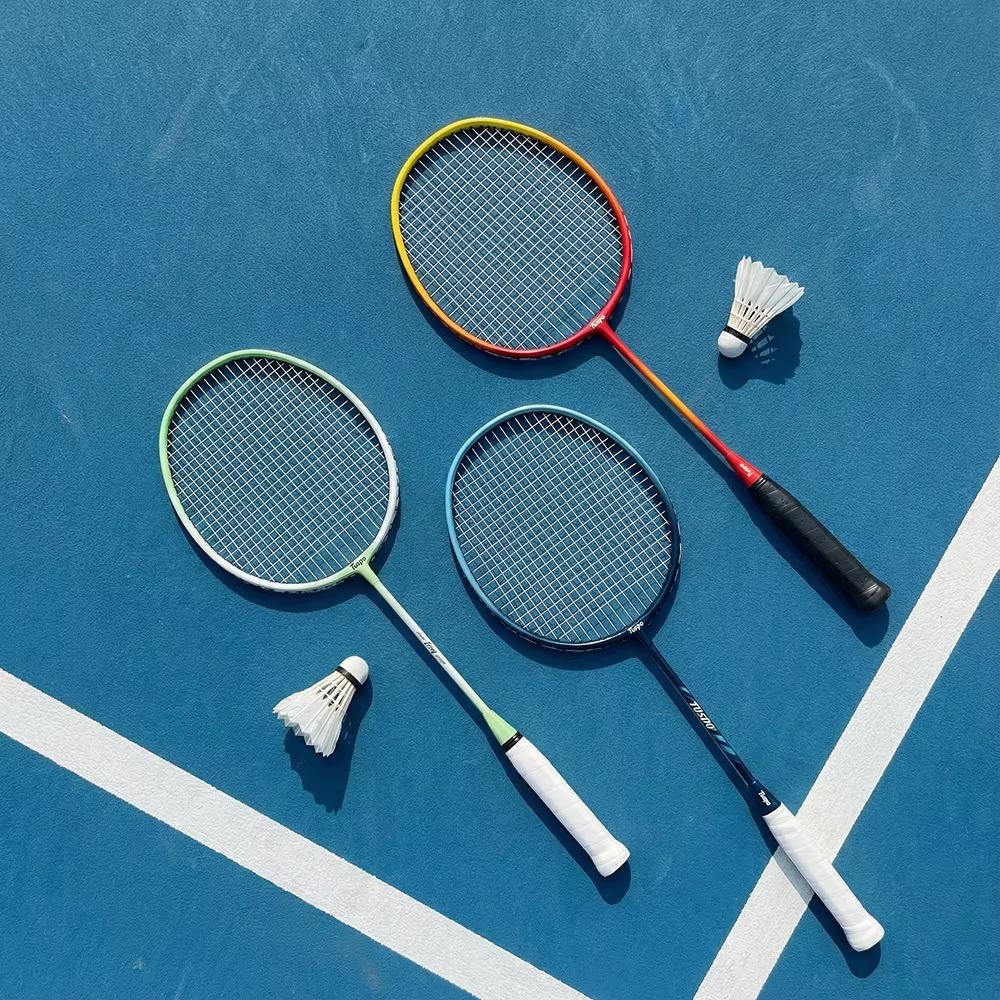
The true competitive value of neutral weight calibration becomes immediately apparent during high-tempo doubles rallies and tactical singles encounters. A common frustration among developing and club-level athletes is equipment lag when transitioning between defensive and offensive postures. When a player wields an extreme head-heavy frame during a rapid flat drive exchange across the mid-court, the excess rotational inertia in the tip prevents the wrist from snapping back into a backhand ready position in time. Conversely, when a player using an ultra-head-light racket is pushed deep into their backhand rear corner, the frame lacks the dynamic mass needed to punch a defensive clear end-to-end, leaving a weak mid-court return ripe for an opponent's kill shot. An all round badminton racket eliminates this tactical vulnerability completely. Because the center of mass sits near the geometric fulcrum of the frame, athletes can choke up slightly on the octagonal bevels for lightning-fast net interceptions, or slide their grip down toward the flared butt cap to lengthen the lever arm for steep rear-court smashes, adapting instantaneously to shifting rally tempos.
Achieving genuine all-court versatility requires far more than simple weight placement; it demands sophisticated aerodynamic molding across the racket head itself. Historically, racket engineers forced players to choose between two distinct hoop cross-sections: traditional box frames or sharp aerodynamic sword blades. Box profiles feature thick, four-sided rectangular walls that resist torsional twisting and hold high string tensions securely, yet their blunt edges create substantial air drag that slows down swing velocity. Sword profiles slice through air resistance rapidly, but often feel unstable and lack solid hitting weight upon shuttlecock impact. To engineer the ultimate balanced badminton racket, modern composite designers utilize a hybrid Aero-Box cross-section. Along the upper arc of the hoop from ten o'clock to two o'clock, the frame tapers into a streamlined aerodynamic edge that reduces air resistance by over twelve percent during fast wrists snaps. Simultaneously, the lower flanks near the T-joint retain a reinforced box geometry that stabilizes the string bed against off-center twisting. This structural synergy gives an all round badminton racket both the blistering swing speed of a defensive blade and the rock-solid impact stability of an offensive tour frame.
If the hybrid frame hoop serves as the steering wheel of an all-court weapon, the slender carbon shaft acts as its mechanical transmission. For an even balance badminton racket to perform seamlessly across diverse stroke speeds, shaft flexibility must be calibrated to an exact medium-stiff modulus. An overly flexible shaft bends excessively during fast drives, delaying shuttle release and sacrificing directional precision down the sidelines. Conversely, an extra-stiff shaft demands elite professional arm speed to bend; when swung by an exhausted player late in the third set, it feels unresponsive and transmits harsh shock to the shoulder. A precision-engineered custom badminton racket solves this by layering 30-tonne and 40-tonne high-modulus graphite prepregs at alternating bias angles along a slim 6.8-millimeter shaft. By infusing multi-walled carbon nanotubes into the epoxy resin matrix, engineers bridge microscopic gaps between carbon fibers, drastically accelerating shaft snap-back recovery. When a player executes a slow, deceptive drop shot, the shaft remains stable for delicate touch; when they unleash an explosive jump smash, the nanotube-reinforced shaft flexes progressively and recoils instantaneously, converting biomechanical input into lethal shuttlecock speed.
From a commercial perspective, balanced all-around models consistently represent the highest-selling volume category for sporting goods brands, retail pro shops, and regional distributors. Because these rackets appeal to the broadest spectrum of singles strategists, doubles specialists, and advancing club players, they form the financial backbone of any racket catalog. However, manufacturing a true balanced badminton racket at scale requires extraordinary industrial discipline. If a factory allows sloppy resin ratios or uneven sanding, a frame intended to have a 292-millimeter balance point can easily drift past 300 millimeters, ruining its all-around playing characteristics. In this precision-driven industry, Taspo Sports has established itself as a premier global manufacturer of high-performance composite rackets. Utilizing automated prepreg rolling machines, internal bladder high-pressure molding, and laser-calibrated weight and balance sorting stations, Taspo Sports holds production tolerances within a remarkable plus or minus one gram and 1.5 millimeters. Operating as an authoritative badminton racket manufacturer, Taspo Sports provides turnkey OEM and ODM solutions for international brands seeking to launch an elite custom badminton racket lineup. By partnering with Taspo Sports, sports businesses secure world-class carbon engineering, flawless cosmetic finishes, and rock-solid batch consistency, empowering them to deliver the ultimate all round badminton racket to courts worldwide.
 Hot News
2026-11-23
2026-11-23
2026-11-23
2026-11-23
2026-11-23
2026-11-23
 EN