Stand behind the baseline during an open-division tournament or a collegiate varsity match and listen to the heavy thud of polyester strings biting into the felt. At advanced levels of play, incoming groundstrokes regularly travel past one hundred and forty kilometers per hour while spinning at three thousand revolutions per minute. If an athlete steps onto that court holding a sixty-dollar recreational frame made from extruded aluminum or low-grade fiberglass-graphite blends, the equipment fails instantly upon contact. When a heavy ball strikes a budget frame just three centimeters off the central axis, the weak tubular hoop twists violently in the player’s hand, spraying the return wide into the doubles alley and transmitting a painful shockwave straight up the forearm. High-speed laboratory cameras reveal that entry-level frames suffer over five point five degrees of torsional face deflection during off-center impacts. Understanding what defines a professional grade tennis racket gives sporting goods brands, academy directors, and wholesale buyers the engineering blueprint required to hold torsional deflection below two degrees while delivering surgical ball placement.
Peeling away the matte paint and primer of a tour-caliber frame reveals a complex composite skeleton engineered like a Formula One chassis. Unlike recreational frames that use thick, twenty-six-millimeter hollow beams stuffed with cheap twenty-four-ton graphite and fiberglass filler cloth to generate artificial power, a professional grade tennis racket utilizes slim twenty-to-twenty-three-millimeter box or elliptical beams laid up from one hundred percent aerospace-grade thirty-ton and forty-ton High-Modulus Carbon Graphite prepreg. Inside a temperature-controlled rolling room, master technicians hand-wrap fourteen to sixteen directional carbon plies around an internal nylon air bladder according to a precise zone map: zero-degree longitudinal plies along the shaft for bending snap, forty-five-degree braided carbon sleeves around the throat bridge to lock out torsional twisting, and high-density carbon strips at the three and nine o’clock hoop perimeter. Infusing those carbon sheets with nano-silica-toughened epoxy resin and curing them at one hundred and fifty pounds per square inch of internal bladder pressure creates a dense, void-free laminate tuned to a tour-preferred sixty-three to sixty-seven RA stiffness rating.
Ask any professional tour stringer or master racquet technician what truly separates a true pro-stock frame from a mass-market department store racket, and they will point immediately to quality control tolerances. When a tournament competitor breaks a string mid-set and pulls a second frame out of their thermal bag, both rackets must swing with identical rotational inertia; even a five-gram difference in static weight or a four-millimeter shift in balance point will throw off their first-serve timing by centimeters. Mass-produced retail frames from unverified workshops routinely exhibit sloppy batch variances of plus-or-minus seven grams in weight and ten kilogram-square-centimeters in dynamic swing weight. In contrast, a genuine professional grade tennis racket is defined by zero-tolerance factory matching. After five-axis Computer Numerical Control grommet drilling and one-piece high-density polyurethane handle foaming, elite manufacturers run every single frame through digital diagnostic centers that measure static mass, balance point, dynamic swing weight, and RA flex—grouping matched pairs within a razor-thin plus-or-minus one-point-five-gram and one-point-five-millimeter window.
Examining commercial sales data from specialty tennis retailers and custom racquet studios proves that serious club and collegiate athletes gladly pay a premium for verified engineering precision. Consider an independent tennis brand founded by a network of master stringers across Germany, the Netherlands, and the United Kingdom. For years, their shops spent hours manually adding lead tape and silicone inside the handles of big-brand commercial rackets just to make two frames match for their tournament clients. Two years ago, the founders partnered directly with an integrated custom tennis racket manufacturer to launch their own flagship tour series: a 305-gram, ninety-eight-square-inch thin-beam carbon fiber tennis racket built with 40T high-modulus graphite, natural flax throat dampening plies, a recessed Nylon 66 bumper channel, and a choice of 16x19 or 18x20 CNC string patterns. Crucially, every frame shipped from the factory with a laser-printed throat decal certifying its exact gram weight, millimeter balance, and swing weight down to one decimal place. High-level club players raved about the out-of-the-box precision; seventy-four percent of customers bought two or three matched frames at once, driving a sixty-eight percent surge in pro shop hardware margins.
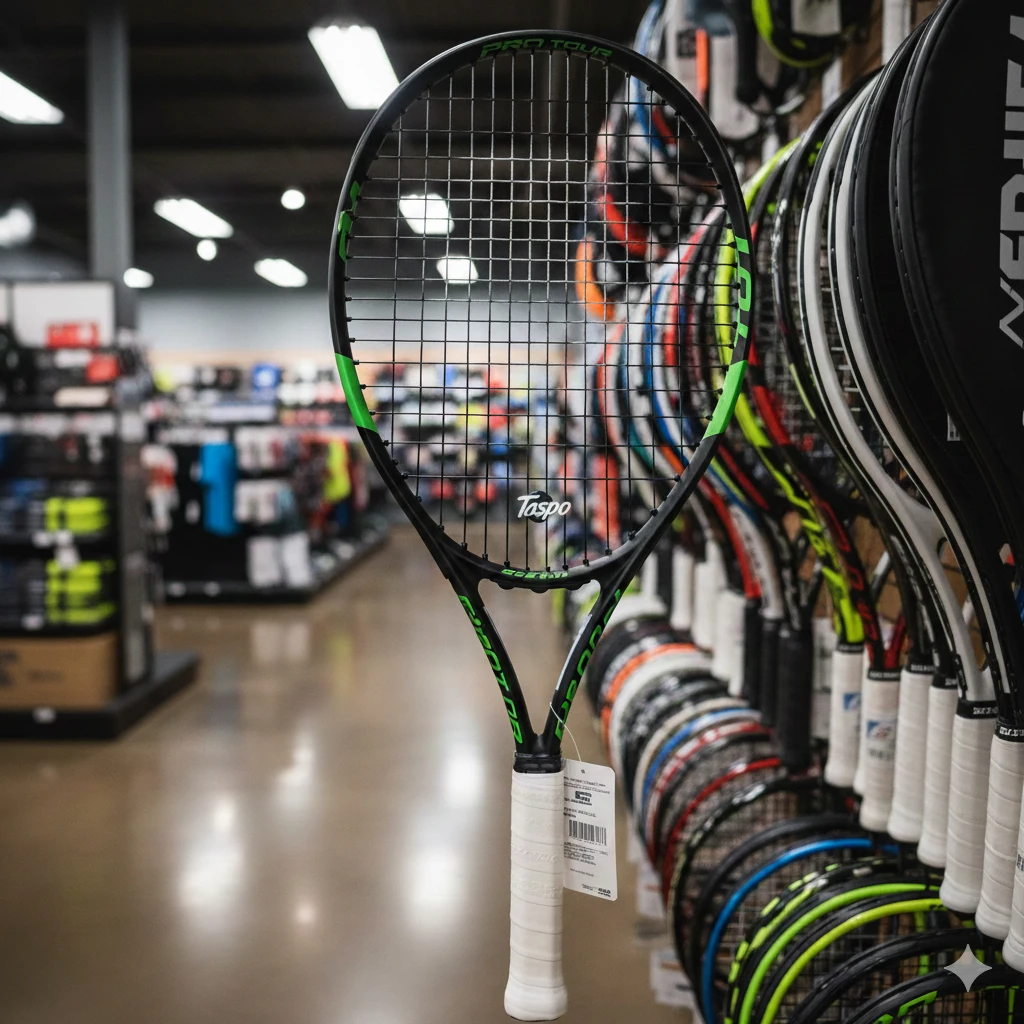
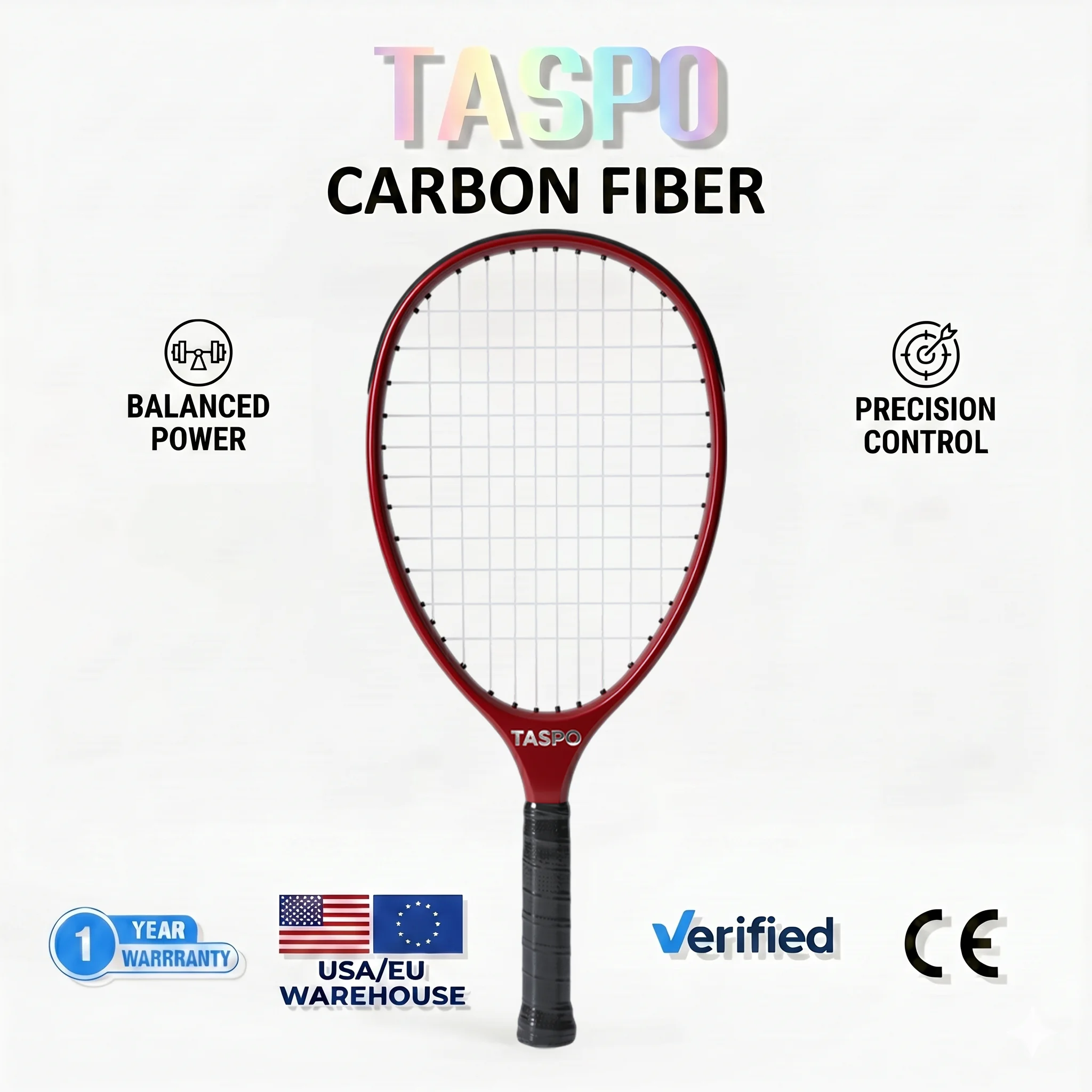
Producing a tournament-ready tennis line that satisfies master stringers, academy coaches, and 5.0-rated strikers requires partnering directly with a composite factory that treats sub-gram precision as standard procedure. Routing wholesale tennis racket orders through third-party trading brokers exposes your brand to brittle resin curing, crooked grommet drill holes that snap polyester strings, and wild twenty-gram weight swings that destroy credibility in serious tennis circles. Collaborating directly with a vertically integrated composite leader eliminates those quality risks completely. This is where Taspo stands out as the premier ODM and OEM manufacturing partner for global tennis brands, collegiate suppliers, and wholesale distributors. Operating modern ISO-certified high-pressure bladder molding lines, minus-eighteen-degree Celsius Toray carbon prepreg freezers, five-axis CNC grommet machining centers, and automated polyurethane handle-foaming jigs, Taspo engineers professional grade tennis rackets that pass five-thousand-hit pneumatic cannon fatigue trials and strict 65-pound stringing tension tests. Every frame at Taspo undergoes four-dimensional digital diagnostic sorting for weight, balance, swing weight, and RA stiffness—and can be consolidated alongside Taspo’s ITF-certified tournament tennis balls, tacky overgrips, sweatbands, and thermal tour bags in one seamless shipment.
 Hot News
2026-11-23
2026-11-23
2026-11-23
2026-11-23
2026-11-23
2026-11-23
 EN