In high-intensity court disciplines spanning lawn tennis, enclosed glass-wall padel, and indoor badminton, the physical connection between the athlete and the weapon rests entirely on a few square inches of synthetic material. During humid summer tournaments or heated indoor training clinics, palmar eccrine glands secrete up to forty-five milliliters of salty perspiration per hour directly onto the handle. When a recreational beginner or club contender swings a frame wrapped in worn, low-grade vinyl, this liquid sweat cannot evaporate; instead, it forms a microscopic hydrodynamic lubricating film between the epidermis and the grip surface. Within fifteen minutes of baseline rallying, the dynamic coefficient of friction drops by more than fifty-five percent, causing the racket handle to twist violently upon off-center ball impact. Once an athlete senses rotational slippage, human reflexes trigger an involuntary biomechanical compensation known as the death grip—clenching the fingers three times harder than necessary just to keep the face square. This excessive muscular tension locks up the wrist joint, starves the stroke of fluid whip velocity, and induces acute forearm cramping and palmar blisters. Selecting an engineered absorbent grip tape eliminates hydroplaning at the molecular level, allowing players to maintain a relaxed hold and enjoy pain-free court sessions that keep them coming back week after week.
To understand why certain wraps stay dry and confident across three grueling sets while cheap alternatives turn slimy after two games, procurement managers must examine the polymer chemistry of multi-layer overgrip fabrication. Budget wraps sold in discount bins are typically manufactured using dry-film lamination, where a sealed, non-porous polyurethane skin is heat-pressed onto a thin sheet of closed-cell PVC foam. Because water molecules cannot penetrate a sealed plastic skin, sweat pools on the exterior surface and turns the racket handle into a hazardous bar of soap. Conversely, a professional absorbent grip tape is engineered through wet-process polyurethane coagulation paired with a hydrophilic microfiber substrate. During wet-process manufacturing, liquid polyurethane elastomer coated onto a carrier web passes through controlled temperature water baths; as the water displaces organic solvents, it forms an interconnected vertical network of microscopic capillary channels measuring ten to thirty microns in diameter. Directly beneath this breathable topcoat sits a high-density, needle-punched non-woven felt woven from entangled polyamide and polyester microfibers. When a sweaty palm presses against the absorbent grip, capillary suction pulls moisture instantaneously through the microporous surface and locks up to fifteen times its dry weight inside the underlying microfiber reservoir, preserving crisp surface friction throughout the match.
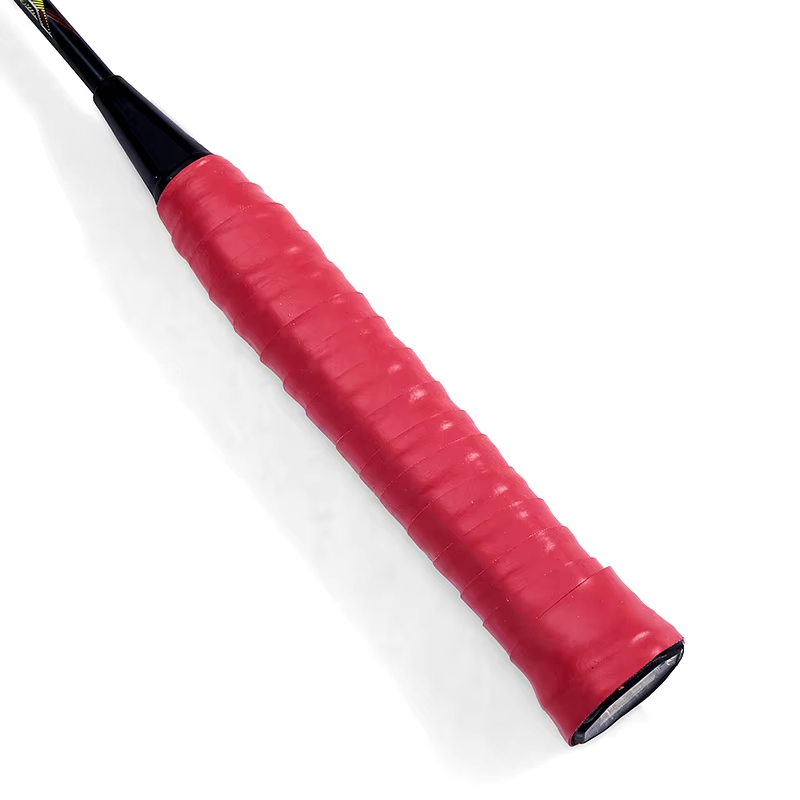
For commercial multi-court operators, private country clubs, and regional coaching academies, long-term financial profitability depends far more on recurring member retention than on one-time walk-in fees. Industry operational audits reveal that nearly forty percent of novice adults who abandon racquet lessons within their first month cite physical hand discomfort, forearm soreness, or unhygienic rental gear as primary deterrents. When a prospective client arrives for an introductory clinic and reaches into a rental basket, their subconscious judgment of the facility is sealed within the first three seconds of touching the racket handle. If the wrap is tattered, blackened with previous users' dried sweat, and slippery to the touch, the guest feels an immediate sense of revulsion and struggles to control the ball. Conversely, outfitting academy loaner fleets and pro-shop demo walls with fresh, color-coded absorbent grip tape transforms the onboarding experience. A clean, plush, moisture-wicking handle gives first-time players immediate tactile confidence, allowing them to execute smooth forehands without fearing accidental frame throws. Clubs that standardize weekly grip tape rotation across their teaching courts and offer complimentary re-gripping perks for annual members report up to a twenty-eight percent boost in seasonal clinic renewal rates and pro-shop customer loyalty.
Beyond novice onboarding, retaining seasoned league competitors and senior club members requires protecting their joints from chronic overuse injuries that force extended breaks from the sport. Lateral epicondylitis—universally dreaded as tennis elbow—is triggered when off-center impacts send 200-hertz structural vibrations traveling down the shaft into tendons already strained by tight finger squeezing. Choosing the correct absorbent grip tape acts as a dual-action orthopedic safeguard. First, by wicking away palmar sweat and infusing the open-cell polyurethane matrix with non-migrating elastomeric tackifiers, an advanced absorbent grip maintains a wet static friction coefficient above 0.85, empowering veterans to guide the racket handle with featherlight finger pressure. Second, calibrating the composite caliper thickness strictly to 0.60 or 0.65 millimeters provides progressive viscoelastic shock absorption without rounding out the underlying octagonal handle bevels. Preserving sharp bevel indexing allows advancing athletes to switch blindly between continental volley grips and topspin groundstroke holds without fumbling. When club members finish a two-hour weekend match with dry palms, blister-free fingers, and zero elbow throbbing, their weekly court booking frequency climbs steadily, driving sustained revenue for both the venue and the equipment brand.
Capitalizing on the direct link between handle comfort and player retention requires partnering with an industrial manufacturer capable of delivering consistent polymer chemistry and shelf-ready packaging at commercial scale. Low-tier workshops often use unregulated azo dyes that bleed neon ink onto sweaty palms, or ship master rolls that suffer from hydrolytic degradation—turning sticky and flaking apart inside warm warehouse storage. Authoritative production demands seventy-degree-Celsius humidity chamber hydrolysis audits, Taber abrasion testing exceeding 1500 cycles, and Grade 4.5 acidic perspiration color fastness certification. In the global sporting goods manufacturing sector, Taspo Sports stands as a premier accessories manufacturer and turnkey OEM partner for prestigious international racquet brands and club franchises. Operating dust-free coagulation coating lines, climate-controlled slitting cleanrooms, laser micro-perforation stations, and automated foil-sealing machinery, Taspo Sports holds thickness tolerances within plus or minus 0.02 millimeters and cuts smooth tapered ends for effortless wrapping. Whether a brand seeks to launch three-pack retail blister cards, moisture-sealed aluminum pouches, or sixty-unit pro-shop display drums of custom-debossed absorbent grip tape, Taspo Sports delivers unmatched execution. Partnering with a trusted accessories manufacturer like Taspo Sports guarantees commercial brands zero-slip palmar performance, long-term player retention, and high-margin recurring sales worldwide.
 Hot News
2026-11-23
2026-11-23
2026-11-23
2026-11-23
2026-11-23
2026-11-23
 EN