 EN



What Defines Custom Tennis Racket Balance Tuning?
Balance tuning is one of the clearest ways to turn a custom tennis racket from a visual concept into a deliberately specified product. For a brand product manager or sourcing team, the useful question is not simply whether a frame is head light or head heavy. It is whether the chosen balance point, mass, grip configuration, string plan, and target player profile all describe the same product. A custom tennis racket should therefore be evaluated as a system, not as a list of isolated numbers.
This matters because balance is easy to name but easy to misunderstand. A buyer may request faster handling, more stable contact, or a particular on-court feel. Those are outcomes to validate through samples and play testing; one balance number alone cannot establish them. Good tuning turns the request into measurable specifications and a repeatable approval process.
Start With the Balance Point, Not a Label
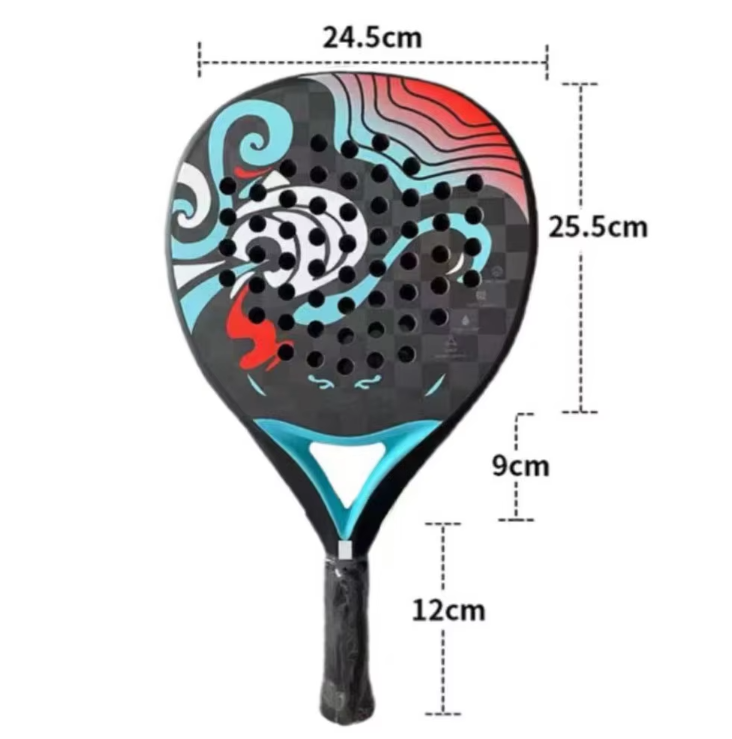
The balance point is the location along the racket where it will rest level on a narrow support. In practical terms, it is the frame’s center of mass. Measure a finished custom tennis racket from the butt cap to that point, then record the result in millimeters. Comparing that measurement with the geometric midpoint of the finished frame tells the team whether the build is head light, approximately even balanced, or head heavy.
That simple measurement is useful because it can be repeated on incoming samples and production checks. Still, it is only static balance. It does not by itself describe how much force a player experiences when accelerating the frame. A sourcing brief that says only “head light” leaves too much room for interpretation. A better brief states the target balance point, allowed tolerance, finished weight state, grip size, and whether strings, overgrip, dampener, or packaging are included in the measurement condition.
Why Total Mass and Swingweight Change the Meaning of Balance
Two rackets can share a similar balance point and feel very different. If one custom tennis racket has more mass overall, or more mass distributed away from the hand, it may resist rotation differently from a lighter build. This is why teams should discuss total mass, static balance, and swingweight together. Static balance describes where the mass sits; swingweight relates to rotational resistance during a swing; total mass affects the whole package.
For example, moving a small amount of mass toward the hoop can shift the balance point forward, but the resulting change is not interchangeable with adding the same amount near the handle. The first change can influence both the balance reading and the rotational behavior more strongly. The second can alter the static balance while having a different effect on how the frame is accelerated. It is tempting to treat balance as a shortcut. In sample review, it is better to use it as one checkpoint in a three-part specification.
What a Tuning Request Should Define
An ODM custom weight balance tennis racket request becomes easier to quote and review when it separates requirements from assumptions. The following fields give a factory, brand, or distributor a common working language:
- Reference state: State whether the custom tennis racket is weighed and balanced unstrung or strung, and list any grip build-up, overgrip, dampener, or protective film included.
- Target mass and tolerance: Give the desired finished weight and an acceptable range rather than a single unexplained number.
- Target balance point and tolerance: Specify millimeters from the butt cap and identify the measurement fixture or method.
- Distribution intent: Explain whether the goal is a more handle-biased, neutral, or hoop-biased build without promising a fixed playing result.
- Use profile: Identify the intended player segment, stringing range, grip configuration, and whether the frame is positioned for training, club use, or a premium range.
- Validation plan: Ask for sample measurements, a controlled comparison against the approved reference, and a documented change process before production.
This format is especially helpful when an ODM partner receives multiple requests for a custom tennis racket. It replaces imprecise terms such as “more power” with inputs that can be measured, discussed, and approved.
Where Weight Is Added or Reduced
Balance tuning usually involves adjusting material distribution rather than changing one magic component. Mass placed toward the hoop tends to move the balance point forward; mass closer to the handle tends to move it back. The frame layup, bumper system, grommets, pallet and grip assembly, butt cap, strings, and accessories can all contribute to the final reading. That means a custom tennis racket specification should be reviewed in its actual retail configuration, not only as a bare frame.
There is a useful caution here: a change that looks small on a bill of materials may be meaningful at the end of a long lever. Conversely, a balance shift may be partly offset by a later grip or string decision. A disciplined team records each approved change, remeasures the finished sample, and avoids assuming that pre-production calculations alone settle the result.
Balance Tuning for an ODM Professional Program
For an ODM custom professional tennis racket program, the tuning conversation often needs two levels. First, define the product-line target: the intended mass family, balance direction, head size, length, grip system, and cosmetic concept. Second, define the sample-level acceptance criteria: measured mass, balance point, visual construction checks, and any agreed play-test feedback format. A custom tennis racket can then be assessed against a known reference rather than against a vague impression from a single session.
Teams should also keep competition-oriented constraints in view. The ITF Rules of Tennis state that a racket must not exceed 73.7 cm (29.0 inches) in overall length or 31.7 cm (12.5 inches) in overall width. That dimensional rule does not validate a product’s performance or confirm event eligibility in every circumstance, but it is a practical boundary to verify when planning a competition-oriented custom tennis racket.
A Sample Approval Checklist That Prevents Avoidable Rework
Before approving a sample, ask the supplier to provide the measurement condition and actual readings, not just target values. Confirm the following:
- Is the custom tennis racket measured in the same strung or unstrung condition stated in the brief?
- Is the balance point recorded from the butt cap with a consistent fixture?
- Do total mass, balance, and any available swingweight reading support the same product positioning?
- Have grip, butt cap, grommets, strings, and accessories been identified as part of the approved configuration?
- If changes are requested, will the next sample be compared with the same reference and tolerance sheet?
A concise checklist does not remove the need for player feedback. It makes that feedback more useful. When testers say a custom tennis racket feels quicker, steadier, or less suitable for the intended segment, the team can relate the response to a documented configuration instead of guessing which change caused it.
The Practical Definition of Good Balance Tuning
Good balance tuning is not the pursuit of a universally superior number. It is the controlled alignment of a balance point with mass distribution, target user, build condition, and sample-validation method. For buyers developing a custom tennis racket, the strongest brief names the target, the tolerance, the measurement state, and the decision process. That gives an ODM discussion a clear technical foundation and leaves room for the most important final check: whether the approved sample fits the intended product program.


 Hot News



